How to Safely Introduce a Parrotlet to a Senior Cat
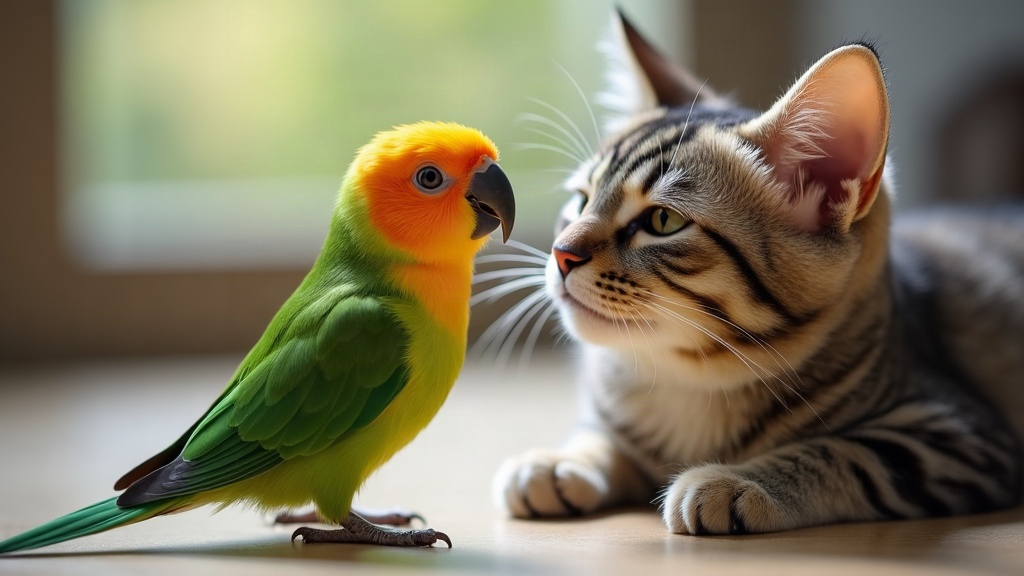
How to Safely Introduce a Parrotlet to a Senior Cat
Bringing a tiny, energetic parrotlet into a home with an older cat can absolutely work. But it only works if you handle the introduction with patience and firm boundaries. A parrotlet weighs about 28 to 33 grams, roughly the same as a large mouse, and that’s exactly why a cat’s prey drive is the biggest thing you’re managing here. The upside? Senior cats tend to be calmer and less playful than kittens, which usually makes this whole process easier, as long as you move slowly and never push the two of them together before they’re ready. Below is a stage-by-stage walkthrough, from quarantine to the first supervised moments in the same room.
Understand the Two Personalities First
Parrotlets have a reputation for being fearless, and it’s earned. Despite being smaller than your palm, they’ll dive-bomb a cat, puff up twice their size, or screech to defend “their” corner of the room without a second thought. A senior cat is the opposite: slower, sleeps more hours than you’d expect, and might be dealing with arthritis or fading eyesight. That lower energy helps you, but don’t mistake it for retirement of instinct. Even the gentlest old cat can still swat out of surprise, or pure self-defense, if a bird suddenly zips past its face.
Before you do anything else, check that your cat is in good health and that your parrotlet has actually settled into its new cage. A stressed bird paired with a startled cat is a recipe for an accident.
Stage 1: Set Up a Separate Safe Room
Start with the parrotlet in a room the cat physically cannot get into.
- Quarantine (7 to 14 days): Keep the bird isolated for at least a week. This gives you time to watch for signs of illness and lets the bird start bonding with you before it has anything else to worry about.
- Cage placement: Put the cage against a wall, away from drafts and direct sun, roughly at chest height. Birds feel safer with a solid surface at their back rather than open space on all sides.
- Bar spacing matters: Choose a cage with bars no more than 1/2 inch (1.3 cm) apart. Anything wider and a curious paw can reach right through, which has ended badly for more than a few birds.
Keep that door shut, no exceptions, during this whole phase. What you’re going for is the cat treating the bird’s presence as background noise, nothing worth investigating.
Stage 2: Scent and Sound Introduction
Now let them get used to each other without ever seeing one another.
- Swap scents: Rub a soft cloth over your cat’s cheeks (where their scent glands are), then leave it near, not inside, the bird’s cage. Do it the other way too: a cloth from near the cage, given to the cat to sniff. Repeat this daily.
- Share sounds: Play a recording of parrotlet chirps at low volume near the cat, or just let the cat hear the bird’s noise through a closed door.
- Reward calm behavior: Any time your cat hears the bird and just… stays relaxed, doesn’t tense up, doesn’t stare, give it something worth having. A bit of cooked chicken or its favorite kibble works well.
Expect this stage to take one to three weeks. Don’t rush it. A senior cat needs real time to file this new sound and smell under “not a threat, not interesting.”
Stage 3: Visual Introduction Through a Barrier
This is where they finally see each other, but still can’t touch.
- Put the cat on a harness and leash, or set the bird’s cage in a room with a screen door or closed glass door separating them.
- Keep it brief, 5 to 10 minutes tops, and try to end things while everyone’s still calm rather than pushing for “just a bit more.”
- Watch the cat’s body language closely: a tail swishing slowly, pupils blown wide and fixed, or a low crouched stalking pose all mean it’s time to stop, right now.
- Watch the bird too. A parrotlet that flattens its feathers, freezes solid, or won’t stop shrieking is scared, not curious, and needs the session cut short.
Do this every day until your cat can glance over at the bird and then just look away, no tension in its shoulders. For a lot of senior cats, that takes two to four weeks.
Stage 4: Supervised Same-Room Time
Once the cat can basically ignore the caged bird, it’s time to try short sessions together in the same room.
- Keep the bird caged for the first several rounds of this. Don’t even think about free-flight time until the cat’s indifference looks genuine, not just tired tolerance.
- Skip the wing clip. It’s not a substitute for supervision, and it leaves a parrotlet with no way to escape if things go wrong.
- Put the cat on your lap or its favorite bed, and hand it a food puzzle or lick mat so its attention has somewhere else to go.
- Keep a spray bottle or rolled towel within reach, but only as a last-resort interrupter, never as punishment. Fear-based correction tends to backfire badly with cats and can undo weeks of progress.
What About Free Flight?
Even after weeks of things going well, don’t ever leave a parrotlet loose in the room with an unsupervised cat. When flight time does happen:
- Lock the cat in another room, or seal off the bird’s flight area completely.
- Shut the windows and cover any mirrors, since a panicked bird will fly straight into glass without hesitation.
- Accept the possibility that your senior cat may just never be trustworthy around a flying bird. Some cats can’t override that chase instinct no matter how much training you do, and that’s a management problem to work around, not a failure on your part.
Red Flags That Mean “Slow Down”
- Cat: stalking, lunging at the cage, pawing at the bars, or that hyper-focused stare that lasts more than a couple of seconds.
- Bird: screaming, panting, plucking its own feathers, refusing food, or refusing to come out of the cage at all.
See any of this? Go back a stage and give it another week. There’s no clock running here. The only real goal is a household where everyone’s calm and nobody gets hurt.
Conclusion
Introducing a parrotlet to a senior cat is slow work, and it rewards the people willing to stay patient through it. Separate rooms first, then scent and sound, then viewing through a barrier, and only then short supervised sessions together, with the bird’s safety always as the one non-negotiable. Keep your expectations realistic and your eyes open, and plenty of homes find that a calm older cat and a bold little parrot can share a house peacefully, each one giving the other the space it needs.